
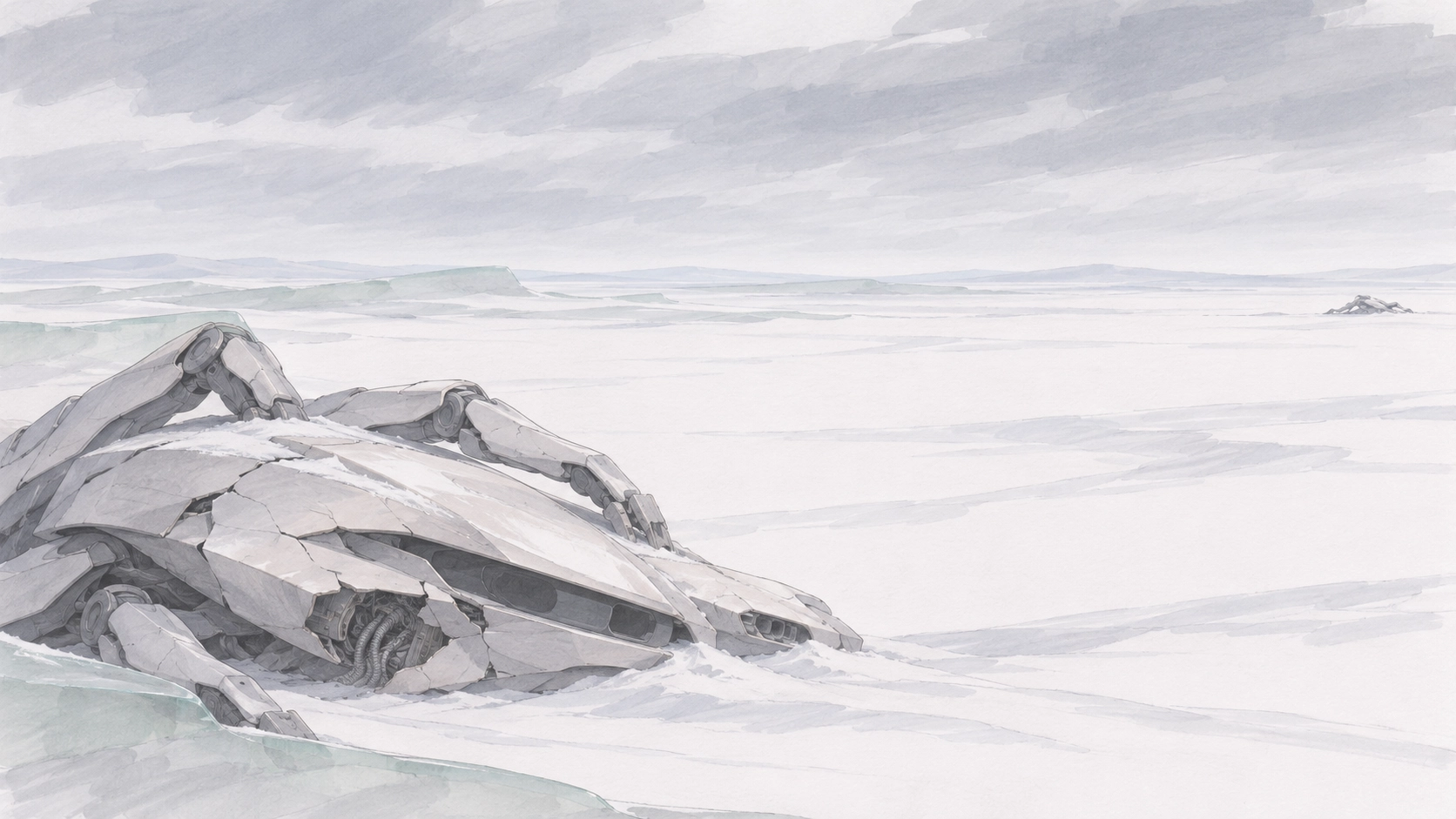
White dust moves across the glass in thin, restless sheets, catching against the armour of wrecks and slipping through the gaps between their plates. Under a low sky, the pale ground stretches so far that its edges disappear, leaving the dark shapes of broken machinery to mark the distance. One automaton lies on its side with its limbs buried beneath a drift; further out, another protrudes from the glass beside the remains of a transport, its fractured hull filled with the same fine powder that covers the fields around it.
The Glass Desert reaches across much of the former upper eastern shelf of the United States, through Canada and into a roughly 275-kilometre stretch of the old Northwest Passage. Its surface changes along the way, from broad, milky expanses worn almost smooth to darker fields where broken sheets catch the light beneath the dust. At the edge of a fracture, the glass turns green, and loose fragments scrape together underfoot.
The wreckage emerges gradually: a piece of armour breaking the surface here, a collapsed limb or a length of exposed machinery there, while larger shapes sit half-submerged in the drifts. Some retain the faded markings of the Old World Government, their designations still visible beneath layers of dust, though the records that might explain where they came from have long since disappeared.
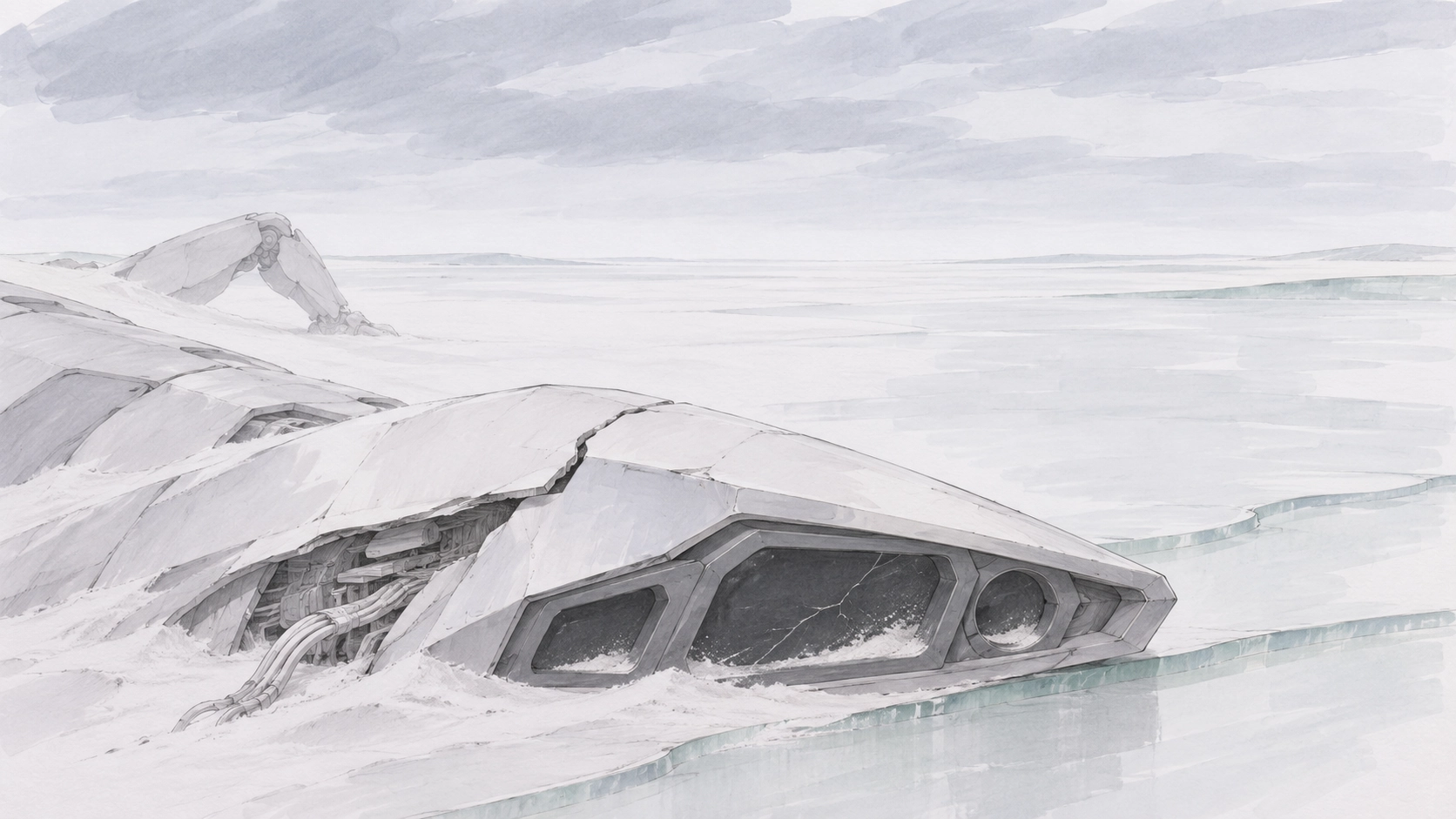
Inside the machines, drives, weapons and control systems carry designs familiar to the modern world. Their builders continued to refine those technologies before the Collapse, and amongst the wreckage lie examples of work that surpassed much of what survives today. Some mechanisms remain sheltered behind damaged armour, even as their housings sink into the glass; others lie in fragments beside the remains of facilities and archives that once held the knowledge to build them. Much of the Old World’s finest work disappeared entirely.
Scattered records speak of deployments and fighting across the region, but too little survives to piece them together, and the exact cause of the glassing remains unknown. The battlefield continues beneath the surface for miles, its full extent concealed by the fields that formed over it.
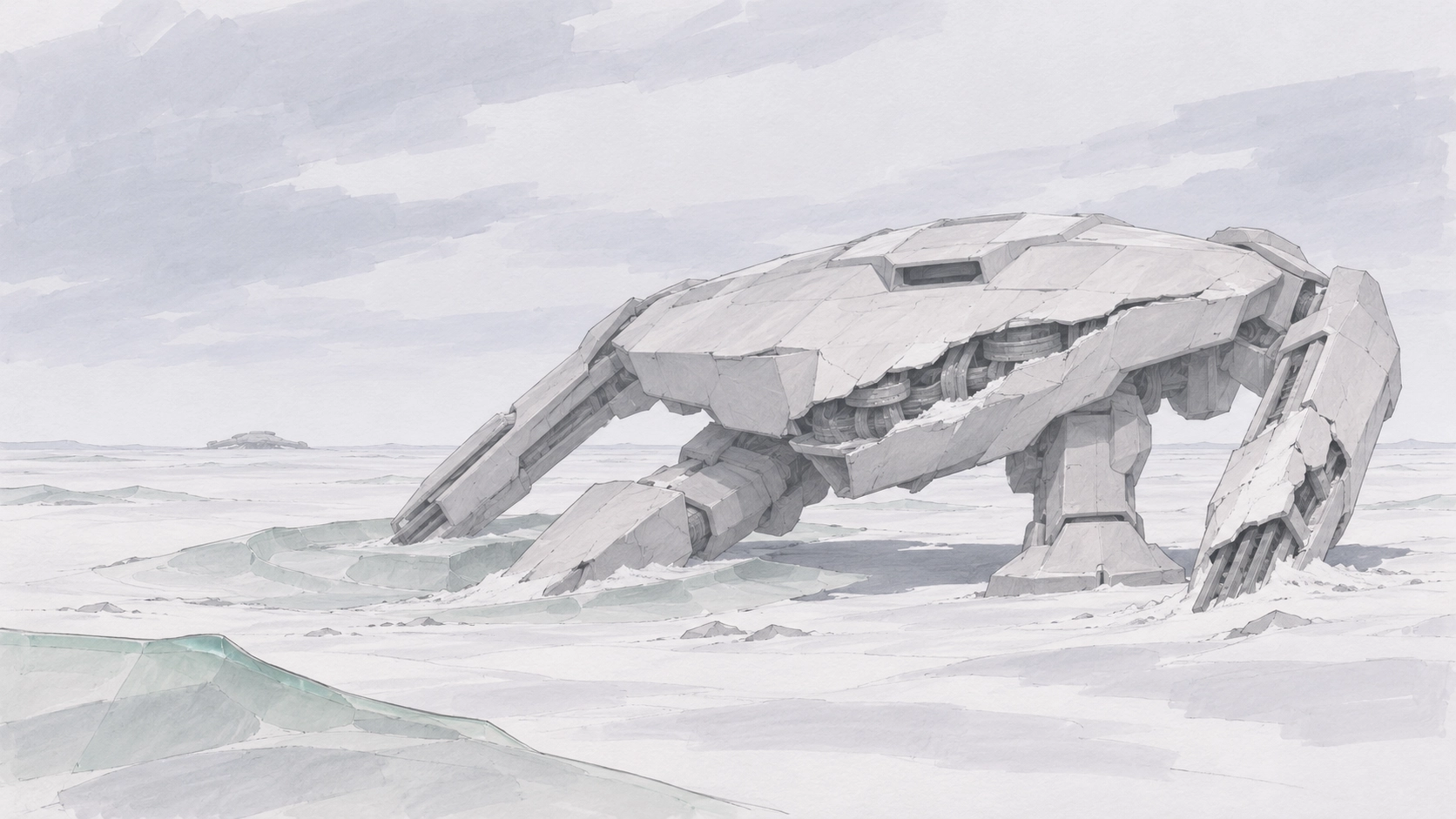
Guard posts and survey markers line the recognised approaches, continuing a watch maintained in one form or another for as long as surviving accounts describe the region. Radioactive contamination keeps the desert uninhabitable, while buried ordnance and unstable glass make each journey further in a risk. Wind strips powder from familiar routes and gathers it over fractures, leaving old tracks to vanish beneath a surface that no longer holds.
Treasure hunters return for unopened compartments, buried installations and intact machinery, following copied surveys and rumours of wrecks that escaped the attention of earlier expeditions. Near the guarded approaches, fresh cuts expose bright metal beneath weathered plates, and discarded components lie beside excavations already filling with dust. Further out, the wrecks remain undisturbed, their outlines growing smaller against the white until they disappear into the distance.